
Importing Indonesian Coconut Charcoal: First-Timer Guide
- 06 Oct 2026
- Tips & Tricks

Many first-time importers of coconut charcoal from Indonesia have done their homework and know two key things: the product originates from Indonesia, and the premium quality is genuinely impressive. However, they often feel uncertain about the actual process, how to locate the right supplier, what specifications to include, how to handle the first shipment, and what common pitfalls to avoid before experiencing them firsthand.
This guide aims to address those questions transparently. While it won't turn you into an expert importer after just one read, it will provide a clear overview of the entire process, from your initial contact with a supplier to the moment the product arrives at your warehouse, highlighting the crucial decisions along the way.
If you already have a specific product in mind, the following guides delve deeper into each category:
- For wholesale buyers of shisha and hookah charcoal
- For distributors of European BBQ charcoal
- For manufacturers of briquettes looking for raw materials
If you're still exploring which product suits your business, begin here.
Step 1: Decide Which Type of Coconut Charcoal You Actually Need
It's a well-known fact, yet first-time buyers often overlook this crucial step, which significantly impacts all subsequent decisions.
CocoCharcoal Universal offers three unique product categories. While they all originate from the same raw materials, they cater to different markets, buyers, and applications:
Shisha Charcoal Briquettes
Shisha charcoal consists of pressed briquettes made entirely from coconut shell charcoal. It is manufactured to strict specifications, as the quality of each batch will be directly experienced by the end user, whether they are at a hookah lounge or enjoying shisha at home.
Target audience: Importers of shisha and hookah products, tobacco distributors, suppliers for shisha lounges, and regional distributors in areas with a vibrant shisha culture, such as the Middle East and Europe.
Key specifications:
- Ash content: maximum 2.5%
- Fixed carbon: above 79%
- Moisture content: around 5–6%
- Available sizes: 22mm to 27mm (cube format)
Full specifications and inquiry form.
BBQ Charcoal Briquettes
BBQ charcoal briquettes are designed for grilling and cooking purposes. Their specifications differ from those of shisha charcoal, allowing for slightly higher moisture levels and a wider range of fixed carbon, reflecting the different performance expectations for their intended use.
Target audience: Importers and wholesale distributors of BBQ products, retailers in outdoor and leisure sectors looking to import directly, private-label BBQ brands, and hospitality buyers sourcing for restaurants or catering services.
Key specifications:
- Moisture content: 6–8%
- Ash content: 3–5%
- Fixed carbon: 70–80%
- Calorific value: approximately 7,000–7,700 kcal/kg
Full specifications and inquiry form.
Coconut Shell Charcoal (Raw Material)
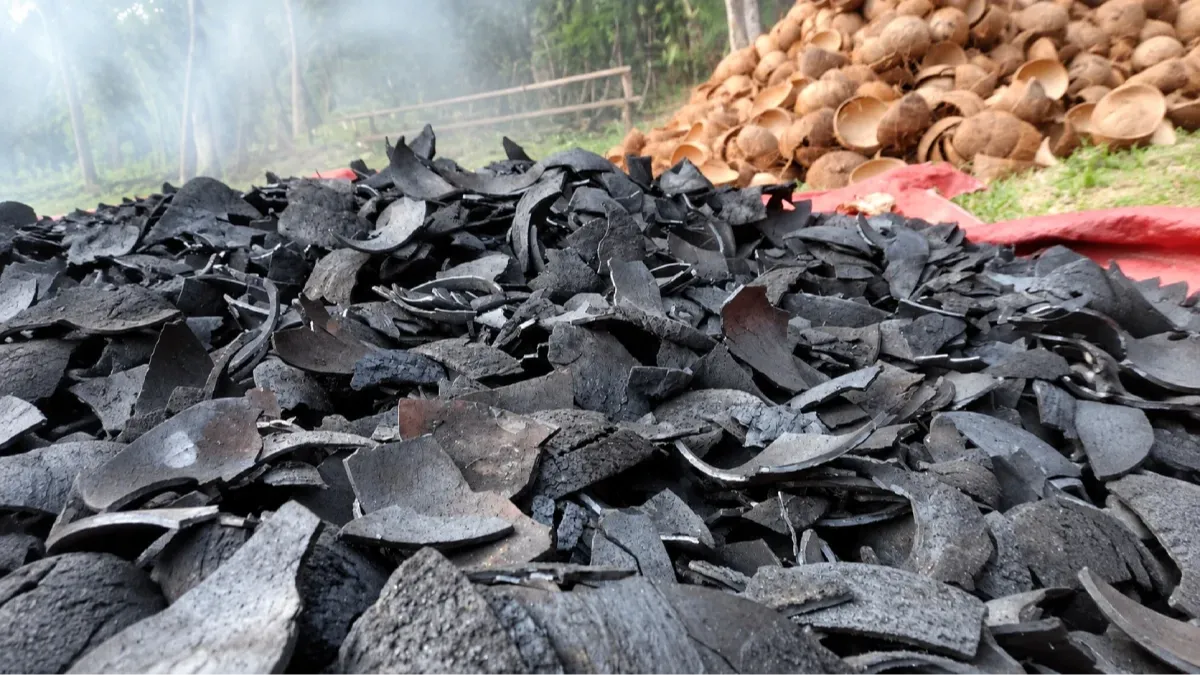
This material is coconut shell that has been carbonized but not yet formed into briquettes. It serves as the feedstock for briquette manufacturers who create finished products.
Who this is for: This is intended for briquette manufacturing facilities looking for raw materials for their production lines, trading companies that procure raw materials for manufacturers, and activated carbon producers assessing coconut shell charcoal as a potential feedstock.
Key specifications:
- Fixed carbon: around 70%+
- Ash content: up to 3%
- Moisture content: up to 12%
Full specifications and inquiry form.
If you're uncertain about which product to choose, a good approach is to think about your end customer or your production process. Consider who you are selling to or what you are producing. The answers will guide you to the appropriate product category.
Step 2: Find and Evaluate Suppliers in Indonesia
Once you've determined the product you need, the next step is to find suppliers who can provide it according to your business's specifications and required volume. This is a critical phase where many first-time importers tend to make hasty decisions.
Where first-time importers search for Indonesian charcoal suppliers:
Most initial inquiries take place on B2B marketplaces like Alibaba, via Google searches, or through referrals from trade directories. While these are all valid starting points, they cannot replace the necessity of directly assessing the supplier you are considering.
A product listing on a B2B platform indicates that a company exists and claims to offer a product. However, it doesn't reveal whether they manufacture it themselves or source it from other suppliers, whether their stated specifications match their actual production capabilities, or if they possess the export experience needed to handle international shipments reliably.
What to consider when evaluating a credible Indonesian coconut charcoal supplier:
- A physical address and verifiable company registration
- Clear product specifications, avoiding vague terms like "premium quality" or "best price," and instead providing actual figures for ash content, fixed carbon, and moisture
- A willingness to supply a certificate of analysis from an independent testing laboratory
- Evidence of export experience, including their ability to discuss documentation requirements, familiarity with your destination market, and logistics for container shipments in detail
- Prompt and specific communication during the inquiry phase; a supplier who clearly addresses your technical questions is more likely to be dependable once you place an order.
CocoCharcoal Universal plays a significant role in this context:
We are an exporter of coconut charcoal products from Subang, West Java, Indonesia. Our products undergo verification by Carsurin, a reputable inspection and testing organization in Indonesia. We provide detailed product specifications on our website and assist buyers throughout the entire inquiry process, from initial contact to the completion of export documentation.
Step 3: Request Specifications and Samples, and Know What to Do With Them
This step is crucial in distinguishing buyers who have seamless first imports from those who face costly mistakes. Requesting specifications and samples is not just a formality; it serves as the essential quality verification step before you invest in a container load.
When requesting specifications:
Reach out to the supplier with your product requirements clearly outlined. Avoid sending a vague inquiry; instead, specify the product type, the necessary specification parameters, your estimated order volume, and your target market. A supplier who can provide a detailed product specification sheet along with a certificate of analysis for a recent production batch is showing the documentation capability you need.
What should a certificate of analysis include?
For coconut charcoal briquettes (whether for shisha or BBQ), a complete COA should detail moisture content, ash content, fixed carbon, and volatile matter, all tested by an independent laboratory, linked to a specific batch, and aligned with the product specifications provided by the supplier.
For coconut shell charcoal raw material, the same four parameters are relevant. However, the moisture content will be higher than that of finished briquettes (up to 12% is typical for raw material), and the fixed carbon will be lower since the raw material hasn't undergone the same level of processing.
Requesting and testing samples:
Always ask for physical samples before placing an order. Any reputable supplier will be willing to fulfill a sample request; this is standard practice and not an unusual request.
When you receive the samples, here’s how to evaluate them:
- For shisha charcoal: Light the briquettes in a hookah setup and assess the heat consistency, ash behavior, odor, and check if the briquettes crack or crumble during the session.
- For BBQ charcoal: Use a real grill setup to test the lighting time, heat output, burn duration, ash accumulation, and see if the briquettes maintain their shape throughout the entire cooking session.
- For raw material: If you’re a manufacturer, conduct a small production trial to see how the material processes through your line and the quality of the finished product it yields.
Make sure to document your findings. If you’re evaluating multiple suppliers, maintaining consistent test conditions will allow for meaningful comparisons.
Step 4: Understand Export Terms Before You Discuss Pricing
First-time importers often jump into discussions about pricing without fully grasping what that price entails. This can lead to confusion and sometimes unexpected expenses.
When sourcing from Indonesia, the two Incoterms you’re most likely to encounter are:
FOB (Free On Board): The supplier's responsibility and costs end once the goods are loaded onto the vessel at the Indonesian port of origin. After that, you take on the responsibility for ocean freight, insurance, and delivery to your destination. Many seasoned importers prefer FOB because it allows them to have direct control over logistics costs through their own freight forwarder.
CIF (Cost, Insurance, and Freight): In this case, the supplier takes care of and pays for ocean freight and insurance to your destination port. While the price you pay to the supplier is higher, it includes the shipping cost. This can make logistics easier for a first order, but it usually means you have less insight into the actual freight costs.
Which option to choose for your first order:
There’s no one-size-fits-all answer. If you already have a freight forwarder you trust, FOB offers more control and transparency. However, if you don’t have a freight forwarder yet and want to simplify your first shipment, CIF might be the better choice, keeping in mind that you’ll likely switch to FOB as you become more experienced with the import process.
Your freight forwarder is the best person to guide you based on your specific market and shipment size. If you haven’t established a relationship with a freight forwarder yet, it’s a good idea to do so before finalizing your first order.
Keep in mind that specific freight costs, customs duty rates, and import clearance requirements can vary by destination market and may change over time. Always verify current figures with your freight forwarder and clearing agent before you finalize your order.
Step 5: Manage Your First Container Shipment
The process of a first container shipment follows a clear set of steps. Knowing the sequence beforehand allows you to manage it smoothly and avoid any unexpected issues.
Before loading the container:
Make sure to confirm your order details in writing, including product type, shape, and size (for briquettes), specification parameters, packaging format, quantity, Incoterms, and destination port. Verify the export documentation package with the supplier, which should include the commercial invoice, packing list, bill of lading, certificate of origin, and certificate of analysis.
If your clearing agent has specific requirements regarding any of these documents, such as format, language, or the issuing body for the certificate of origin, be sure to communicate these to the supplier before loading, not afterward.
During transit:
Maintain communication with your freight forwarder. Confirm when the bill of lading is issued and when the vessel departs. This information is crucial for planning your receiving operations and for providing an estimated arrival date to your customers or production team.
Upon arrival:
Before the product leaves the port, your clearing agent will take care of customs clearance using the export documentation. Ensure you have the COA in hand before the product enters your warehouse, as this will allow you to complete your incoming quality check before distribution or production begins.
Incoming quality check:
Do not overlook this step for a first shipment, even if the samples passed inspection. Inspect a representative sample of briquettes from various positions in the container load, taking samples from the top, middle, and edges of the load against your specification requirements. If you notice significant variations in moisture content or physical condition compared to the COA, document your findings and reach out to the supplier immediately.
Step 6: Build a Recurring Supply Relationship
A first order serves as an evaluation rather than a commitment. Its purpose is to ensure that the supplier can meet their promises, adhere to specifications, provide complete documentation, and deliver within the agreed timeline, all before establishing a recurring supply arrangement.
When the first order is successful, managing the relationship becomes progressively simpler. The supplier becomes familiar with your specification needs and packaging preferences. Your freight forwarder understands the routing, and your clearing agent has the documentation format ready. What initially seems like a complicated process during the first order turns into a routine by the third or fourth order.
Buyers who cultivate the most dependable long-term supply relationships with Indonesian charcoal suppliers are those who clearly outline their requirements from the start, maintain a consistent ordering pattern, and communicate directly when issues with quality or documentation arise.
A supplier who receives clear requirements and consistent orders is motivated to perform well. In contrast, a supplier given vague instructions and irregular orders has less context to work with, which often leads to subpar results.
Common Questions First-Time Importers Ask
Do I need to visit the supplier in Indonesia before placing a first order?
Not necessarily. Most international B2B charcoal supply relationships are built through exchanging specifications, testing samples, and reviewing documentation without needing an in-person visit. While visiting the factory can be beneficial for larger, ongoing supply relationships, it’s not a requirement for your first order.
How much should I order for a first shipment?
This really depends on your storage capacity, expected sales rate, and how much you want to test the supplier's reliability with a significant quantity. An LCL (less than container load) is a sensible choice for a first order if you want to evaluate the product and the supplier's process at a lower volume before committing to a full container. Make sure to discuss this with your supplier and freight forwarder.
What if the product does not match the specification on arrival?
Make sure to document any discrepancies right away, take photographs, measure weights, and compare the Certificate of Analysis (COA), then reach out to the supplier with your evidence. How a supplier handles a quality issue on a first shipment can tell you a lot about whether it’s worth continuing the relationship. A reputable supplier will address genuine quality concerns, while one that deflects or ignores them may not be reliable.
How long does the process take from first contact to product in my warehouse?
The timeline involves evaluating the supplier (which can take days to weeks depending on how quickly you go through specifications and sample reviews), production lead time (which varies by supplier and order size), ocean transit (which depends on the destination; check with your freight forwarder), and customs clearance at the destination. For your first order, it’s wise to allow more time than you think you’ll need. The process often takes longer than expected.
Conclusion
Importing coconut charcoal from Indonesia for the first time may seem daunting, but it’s more manageable than it appears. The steps are clear, decisions are straightforward, and the necessary information is accessible if you ask the right questions.
The most successful first-time importers are those who clearly define their specifications before reaching out to suppliers, test samples prior to committing to a full container, understand their export terms before discussing pricing, and collaborate with a knowledgeable freight forwarder. None of this requires extensive import experience, just a well-defined process.
This guide provides you with that process. Now, the next step is up to you.
CocoCharcoal Universal: Your Gateway to Quality Coconut Shell Charcoal
CocoCharcoal Universal is an exporter based in Indonesia, specializing in coconut shell charcoal products. We offer a range of items including shisha charcoal briquettes, BBQ charcoal briquettes, and raw coconut shell charcoal, all sourced from carefully selected Indonesian coconut shells and verified through Carsurin quality inspections.
We cater to both first-time importers and seasoned buyers with the same level of commitment. The process is straightforward: simply share your product type and specifications, and we will provide you with our product documentation and details on how to obtain samples.
There’s no need for prior experience to start a conversation with us.
Other Article
 Global Trading
 Education
 Education
 Tips & Tricks
 Global Trading